Category:
Mental Health Trainings
Subscription -Monthly Staff
Code:
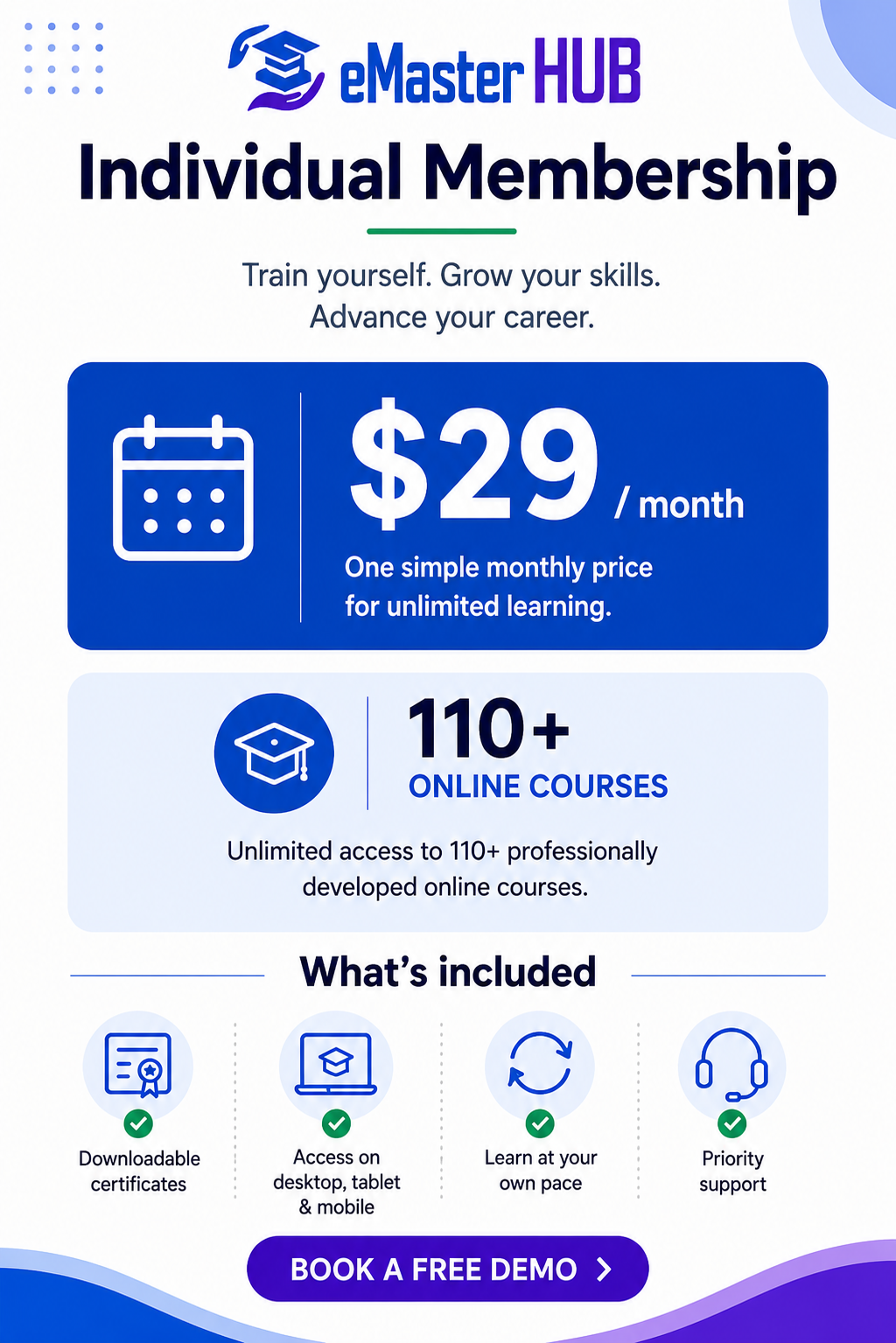
Take your professional development to the next level with the eMaster HUB Individual Membership.
Designed specifically for independent support workers, sole traders, and disability workers, this membership gives you unlimited access to our comprehensive NDIS training library containing professionally developed online courses.
Associated Courses
- A Practical Guide for Support Planning & Goal Setting (NDIS)
- Administering Eye Medication Skills for Disability Support Workers
- Airway Management and Tracheostomy Care in Disability Services
- Basic Clinical Skills for Support Workers — How Not to Step Professional Boundaries
- Basic Oxygen Administration
- Buddy Program New Staff Introduction & Shadow Shift in Disability Services
- COVID-19 Safety in Disability Services
- Complex Bowel Care
- Confidentiality and Information Management for Disability Services and NDIS providers
- Conflict Resolution Skills for Support Workers
- Continence Management
- Creating Positive Workplaces in Disability Service Settings
- Cultural Competency in Disability Services and NDIS providers
- Diabetes Management with Insulin Administration
- Disability Support Worker Orientation Module
- Effective Communication & Relationship‑Building with NDIS Participants in Disability Services
- Food Handling in Disability Service Settings
- Hand Hygiene for Disability Support Workers
- How to Prepare for Emergency & Disaster Management
- How to Support LGBTQ+ NDIS Participants
- Implementing Equality, Diversity, and Inclusion (EDI) in Disability Service Settings
- Implementing Privacy, Dignity and Confidentiality in Care
- Infection Control in Disability Settings
- Introduction to Behaviour Support Plans in Supported Independent Living (SIL)
- Management of Asthma Risks and Emergencies
- Managing Bullying and Harassment in Disability Service
- Managing Client Complaints in NDIS Disability Services
- Managing Participant Money & Property
- Managing Vicarious Trauma (secondary traumatic stress) in Disability
- Manual Handling Essentials in Disability Care Setting
- Mealtime Management and Assistance Training Course
- Medication Administration Training for Disability Support Workers
- Mental Health Medications Basics for Support Workers
- NDIS Code of Conduct Real-Life Applications
- NDIS Compliant Invoicing
- NDIS Finance Essentials PART 1
- NDIS Finance Essentials PART 2
- NDIS Finance Essentials PART 3
- NDIS Finance Essentials PART 4 (Roster of Care)
- NDIS Inclusive Practice
- NDIS Plan Explained and the role of SIL
- NDIS Quality & Safeguards in SIL setting
- NDIS SIL reporting and evidence collection
- NDIS Travel and Transport
- Nebuliser Training in Care Setting
- Ostomy and Stoma Care
- PEG Feeding for Children
- PEG feeding for Adults
- PPE How to Use Personal Protective Equipment in a Disability Service Setting
- Pain Recognition and Management Skills for Support Workers in Disability Care
- Person-Centred Supports in practise
- Practising Individual Values & Beliefs with Participants
- Pressure Injury and Wound Care Management
- Preventing Slips, Trips & Falls in Disability Support
- Professional Boundaries in Disability Support Work (Staff-Focused Training Course)
- Quality Assurance & Compliance Essentials for Disability Support Workers
- Respond to Anaphylaxis in Care Setting
- Risk Management Essentials for NDIS Providers
- SIL Documentation Essentials (Education Pack)— Part 2: Care, Health & Behaviour
- SIL Documentation Essentials (Education Pack)— Part 3: House Ops, Safety, Incidents & Complaints
- SIL Documentation Essentials (Education Pack)— Part 5: Transport, Finance & Admin
- SIL Documentation Essentials – Part 1_ Participant Core & Planning
- SIL Documentation Essentials – Part 4 House Gov, Food Safety & Ops Records
- SIL Quoting Essentials
- Safe Transportation for NDIS Participants
- Safeguarding people with disability from violence, abuse, neglect, exploitation, and discrimination
- Service Agreements with Participants
- Skin Integrity Management in Residential Care
- Sleep Apnea Training – CPAP & BiPAP in Care Settings
- Suicide Prevention and Reporting in SIL settings
- Support Participants with Developmental Delay
- Support Participants with Spinal Cord Injury
- Supporting Participants with Stroke
- Supporting NDIS Participants Towards their NDIS Goals
- Supporting NDIS Participants with Amputation
- Supporting Participants Parkinson Disease
- Supporting Participants Requiring Oral Suctioning
- Supporting Participants personality Disorders
- Supporting Participants with PTSD
- Supporting Participants with ADHD
- Supporting Participants with Acquired Brain Injury (ABI)
- Supporting Participants with Alzheimer’s
- Supporting Participants with Autism Spectrum Disorder
- Supporting Participants with Bipolar Disorder
- Supporting Participants with Dementia
- Supporting Participants with Depression
- Supporting Participants with Down Syndrome
- Supporting Participants with Dysphagia
- Supporting Participants with Multiple Sclerosis (MS)
- Supporting Participants with Obesity in Residential Care
- Supporting Participants with Psychosocial Disability
- Supporting Participants with Schizophrenia A Practical approch
- Supporting Participants’ Mental Health
- Supporting People with Motor Neurone Disease
- Supporting Quadriplegic Participants in Residential Care Settings
- Supporting Spiritual/religious Needs of NDIS Participants in Disability Service
- Supporting participants Obsessive Compulsive Disorder
- Supporting participants with Epilepsy and Seizure
- Supporting participants with Huntington’s Disease
- Supporting participants with Intellectual Disability
- Trauma-informed care in Residential care setting
- UTIs Identification and Management Skills for Support Workers
- Understanding and Supporting Anxiety Disorders
- Urinary Catheter Management
- Ventilation and Tracheostomy Management
- Waste Handling in Disability Service Settings
- Working With Young NDIS Participants (9–18)
- Working with CALD Participants Effectively
- Working with Plan Managers for NDIS Providers
- Working with participants with AOD issues
- Workplace Wellbeing: Self-Care & Stress Management for Disability Support Workers
Associated Courses
- A Practical Guide for Support Planning & Goal Setting (NDIS)
- Administering Eye Medication Skills for Disability Support Workers
- Airway Management and Tracheostomy Care in Disability Services
- Basic Clinical Skills for Support Workers — How Not to Step Professional Boundaries
- Basic Oxygen Administration
- Buddy Program New Staff Introduction & Shadow Shift in Disability Services
- COVID-19 Safety in Disability Services
- Complex Bowel Care
- Confidentiality and Information Management for Disability Services and NDIS providers
- Conflict Resolution Skills for Support Workers
- Continence Management
- Creating Positive Workplaces in Disability Service Settings
- Cultural Competency in Disability Services and NDIS providers
- Diabetes Management with Insulin Administration
- Disability Support Worker Orientation Module
- Effective Communication & Relationship‑Building with NDIS Participants in Disability Services
- Food Handling in Disability Service Settings
- Hand Hygiene for Disability Support Workers
- How to Prepare for Emergency & Disaster Management
- How to Support LGBTQ+ NDIS Participants
- Implementing Equality, Diversity, and Inclusion (EDI) in Disability Service Settings
- Implementing Privacy, Dignity and Confidentiality in Care
- Infection Control in Disability Settings
- Introduction to Behaviour Support Plans in Supported Independent Living (SIL)
- Management of Asthma Risks and Emergencies
- Managing Bullying and Harassment in Disability Service
- Managing Client Complaints in NDIS Disability Services
- Managing Participant Money & Property
- Managing Vicarious Trauma (secondary traumatic stress) in Disability
- Manual Handling Essentials in Disability Care Setting
- Mealtime Management and Assistance Training Course
- Medication Administration Training for Disability Support Workers
- Mental Health Medications Basics for Support Workers
- NDIS Code of Conduct Real-Life Applications
- NDIS Compliant Invoicing
- NDIS Finance Essentials PART 1
- NDIS Finance Essentials PART 2
- NDIS Finance Essentials PART 3
- NDIS Finance Essentials PART 4 (Roster of Care)
- NDIS Inclusive Practice
- NDIS Plan Explained and the role of SIL
- NDIS Quality & Safeguards in SIL setting
- NDIS SIL reporting and evidence collection
- NDIS Travel and Transport
- Nebuliser Training in Care Setting
- Ostomy and Stoma Care
- PEG Feeding for Children
- PEG feeding for Adults
- PPE How to Use Personal Protective Equipment in a Disability Service Setting
- Pain Recognition and Management Skills for Support Workers in Disability Care
- Person-Centred Supports in practise
- Practising Individual Values & Beliefs with Participants
- Pressure Injury and Wound Care Management
- Preventing Slips, Trips & Falls in Disability Support
- Professional Boundaries in Disability Support Work (Staff-Focused Training Course)
- Quality Assurance & Compliance Essentials for Disability Support Workers
- Respond to Anaphylaxis in Care Setting
- Risk Management Essentials for NDIS Providers
- SIL Documentation Essentials (Education Pack)— Part 2: Care, Health & Behaviour
- SIL Documentation Essentials (Education Pack)— Part 3: House Ops, Safety, Incidents & Complaints
- SIL Documentation Essentials (Education Pack)— Part 5: Transport, Finance & Admin
- SIL Documentation Essentials – Part 1_ Participant Core & Planning
- SIL Documentation Essentials – Part 4 House Gov, Food Safety & Ops Records
- SIL Quoting Essentials
- Safe Transportation for NDIS Participants
- Safeguarding people with disability from violence, abuse, neglect, exploitation, and discrimination
- Service Agreements with Participants
- Skin Integrity Management in Residential Care
- Sleep Apnea Training – CPAP & BiPAP in Care Settings
- Suicide Prevention and Reporting in SIL settings
- Support Participants with Developmental Delay
- Support Participants with Spinal Cord Injury
- Supporting Participants with Stroke
- Supporting NDIS Participants Towards their NDIS Goals
- Supporting NDIS Participants with Amputation
- Supporting Participants Parkinson Disease
- Supporting Participants Requiring Oral Suctioning
- Supporting Participants personality Disorders
- Supporting Participants with PTSD
- Supporting Participants with ADHD
- Supporting Participants with Acquired Brain Injury (ABI)
- Supporting Participants with Alzheimer’s
- Supporting Participants with Autism Spectrum Disorder
- Supporting Participants with Bipolar Disorder
- Supporting Participants with Dementia
- Supporting Participants with Depression
- Supporting Participants with Down Syndrome
- Supporting Participants with Dysphagia
- Supporting Participants with Multiple Sclerosis (MS)
- Supporting Participants with Obesity in Residential Care
- Supporting Participants with Psychosocial Disability
- Supporting Participants with Schizophrenia A Practical approch
- Supporting Participants’ Mental Health
- Supporting People with Motor Neurone Disease
- Supporting Quadriplegic Participants in Residential Care Settings
- Supporting Spiritual/religious Needs of NDIS Participants in Disability Service
- Supporting participants Obsessive Compulsive Disorder
- Supporting participants with Epilepsy and Seizure
- Supporting participants with Huntington’s Disease
- Supporting participants with Intellectual Disability
- Trauma-informed care in Residential care setting
- UTIs Identification and Management Skills for Support Workers
- Understanding and Supporting Anxiety Disorders
- Urinary Catheter Management
- Ventilation and Tracheostomy Management
- Waste Handling in Disability Service Settings
- Working With Young NDIS Participants (9–18)
- Working with CALD Participants Effectively
- Working with Plan Managers for NDIS Providers
- Working with participants with AOD issues
- Workplace Wellbeing: Self-Care & Stress Management for Disability Support Workers
A$29.00 / month
1.5–2 hours X 112+ course
English
100% online (mobile + desktop)
Instant digital certificate on completion
Preview Mode
Subscription -Monthly Staff
HD Quality
Subtitles
Lifetime Access
Need Help? Talk to Our Support Team
Have questions about our courses? Our friendly support team is ready to help you choose the right program, guide your enrollment, and start learning today.

Built by leaders who live and breathe professional growth.
Gain up-to-date skills for supporting people and families in varied situations.
In everything we do, we aim to:
- Turn complex professional goals into clear, actionable growth strategies. We replace "one-size-fits-all" advice with deep customization that addresses the specific challenges of your role and your community.
- Give professionals mastery, not just a resume boost. We focus on building genuine capability and the confidence to lead, ensuring every milestone translates into a measurable community outcome.
- Give organizations a seamless way to keep their teams evolving, aligned, and future-proof. We provide a structured path to excellence that makes it easy to track progress, develop talent, and stay ahead of industry shifts.
Category:
Mental Health Trainings
The eMaster HUB Advantage
Australian-Relevant
Courses are developed by industry experts with deep experience in Australian community services.
Flexible, Online Learning
Courses are delivered online for 24/7 access, ideal for regional teams, busy professionals, and those with multiple commitments.
Practical and Interactive
Each module includes case studies, real-world scenarios, and interactive activities.
Real-world experience
Expert-led, Australian-proven. We teach from real-world experience, not a manual.
- Frequently Asked Questions
Quick Answers for You
We’ve gathered the most common questions about eMaster HUB to help you get information faster. Whether you’re curious about our courses, certifications, or compliance with Australian standards, you’ll find the answers here.
1. What do social work short courses include?
Social work short courses often concentrate on specific topic areas like community outreach, domestic violence, case planning, or safeguarding. They are ideal for professionals seeking targeted development or additional expertise in thematic areas of interest.
2. Who should consider enrolling in drug and alcohol courses?
These courses are well suited to new entrants to the sector, existing support workers seeking skill enhancement, social workers needing continuing professional development, or anyone interested in roles like case management, drug and alcohol support, or domestic violence advocacy.
3. How long do domestic violence online classes take?
Duration varies: short introductory or micro-credential courses can be completed in a hour or two, whereas more intensive professional-development or case management courses may take few hours, depending on depth and delivery mode.
4. Do I receive a certificate after completing these courses?
Yes. our courses come with a certificate of completion which helps validate your skills for employers in community services, social work professional development, or allied health sectors.
5. What skills will I gain from a case management short course?
A case management short course equips you with practical skills in client assessment, individual care planning, service coordination, referral processes, and outcome evaluation. These skills are essential in disability case management, aged care case management, and broader social work contexts.
eMaster HUB: Your dedicated partner
- Emaster is a dedicated growth catalyst designed to bridge the gap between individual professional excellence and broader community success. We believe that progress is most powerful when it happens at every level.
✕
Scroll to Top