
Airway Management and Tracheostomy Care in Disability Services
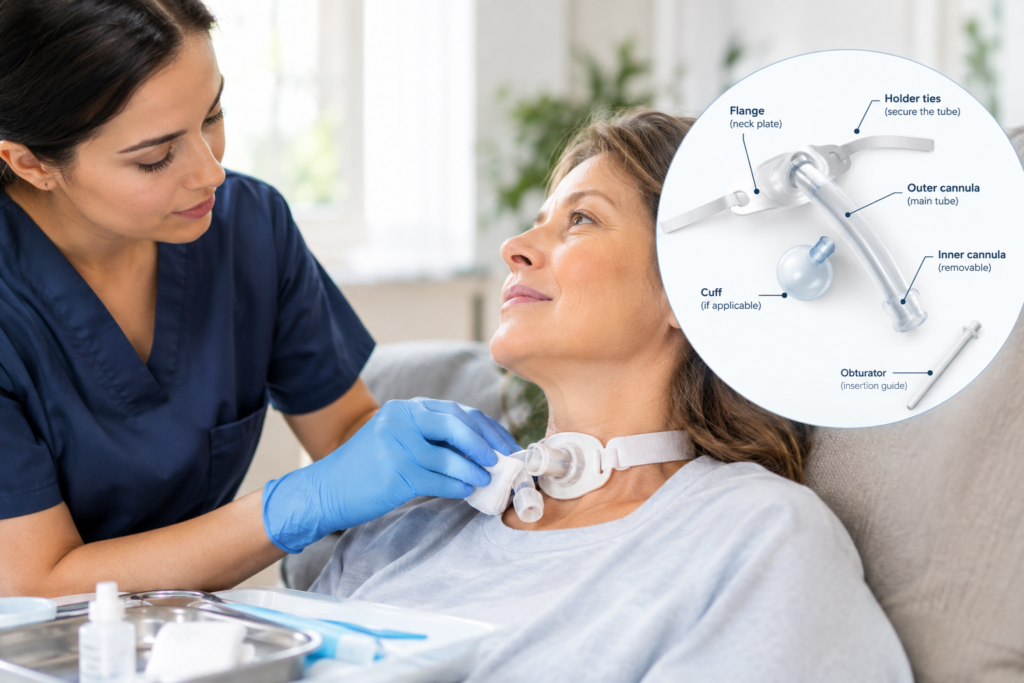
A clinical reference for NDIS support workers, covering tube anatomy, routine stoma care, suctioning technique, infection control, NDIS Practice Standards compliance, and emergency decannulation response. What Is a Tracheostomy? A tracheostomy is a surgically created opening (a stoma) in the front of the neck that provides direct access to the trachea (windpipe), bypassing the upper airway entirely. A hollow tracheostomy tube is inserted through the stoma to maintain the airway and allow breathing. Tracheostomies are performed when a person cannot breathe adequately through the nose or mouth, requires long-term mechanical ventilation, or cannot manage respiratory secretions effectively. For many NDIS participants, a tracheostomy is a permanent or long-term feature of their daily life, not a temporary post-surgical intervention. The support worker may be the only trained person present for most of the participant’s day. Understanding the anatomy of the tracheostomy and the mechanics of the tube is the essential starting point for any support worker stepping into this role. Key Components of a Tracheostomy Tube Modern tracheostomy tubes consist of several interrelated components, each with a specific function: Tracheostomies in the NDIS Disability Context Tracheostomies are significantly more prevalent in the disability population than in the general community. NDIS participants living with neurodevelopmental conditions, acquired brain injuries, spinal cord injuries, and progressive neuromuscular diseases frequently require long-term tracheostomy management as a core element of their daily support needs. Critically, in the NDIS context this care is almost always delivered in community settings: the participant’s own home, a Supported Independent Living (SIL) dwelling, or a respite facility, rather than in a hospital. The clinical supervision provided by hospital nursing staff is absent. A disability support worker may be the sole trained person present for the entirety of a participant’s day, including at night. This reality underpins the seriousness with which training is approached in the NDIS framework. Common conditions among NDIS participants requiring tracheostomy management include: Support Worker Responsibilities in Tracheostomy Care A disability support worker’s role in tracheostomy management is precisely defined by the participant’s individualised Health Support Plan (HSP). That plan, developed by a registered nurse in consultation with the participant, their family, and their treating clinical team, details exactly which tasks the worker is authorised to perform, the specific technique required for this participant, what to document after each care episode, and the escalation pathway when something changes or goes wrong. The breadth of support worker responsibilities typically spans three domains: routine daily care, ongoing observation and documentation, and emergency response. Each domain requires both clinical knowledge and practiced composure. 1. Routine Tracheostomy Care Routine tracheostomy care is performed at least once daily and more frequently during illness or when secretion volumes are high. The overarching goals are to maintain airway patency, prevent infection at the stoma site, and ensure the participant’s comfort and dignity throughout. Inner cannula management is typically the centrepiece of daily care. Secretions and dried mucus accumulate inside the inner cannula; if left unaddressed, this narrows the available airway lumen and increases respiratory effort. The standard approach involves removing the inner cannula, cleaning it with a tracheostomy brush and appropriate sterile solution, rinsing thoroughly under sterile water, and reinserting it, or replacing it with a fresh disposable cannula according to the participant’s supply protocol. Stoma site care addresses the skin immediately surrounding the tracheostomy opening. The skin is cleaned with sterile gauze or swabs, secretions and dried crusting are gently removed, and a tracheostomy dressing (a pre-cut foam pad placed beneath the tube flange) is replaced. This dressing is changed at minimum daily, and immediately whenever it becomes wet or soiled. Tracheostomy ties or holder are inspected and replaced when loose, soiled, or frayed. The fit should allow one finger to pass between the tie and the participant’s neck, secure enough to prevent accidental displacement, with no excess pressure that could damage skin or impair circulation. 2. Suctioning and Secretion Management Tracheal suctioning (passing a sterile suction catheter through the tracheostomy tube to clear secretions the participant cannot expel through coughing) is one of the most clinically significant tasks within a support worker’s potential scope. It requires specific technique, sterile discipline, and clear clinical indication criteria. Suctioning is indicated when observable signs suggest secretion build-up: audible gurgling respirations, visible mucus at the tube opening, increased respiratory rate or work of breathing, or declining oxygen saturation in monitored participants. Importantly, not all participants need regular suctioning. Some have effective coughs and manage secretions independently. The Health Support Plan specifies indication criteria and frequency for each individual. Sound suctioning technique requires: 3. Infection Control Infection is the most frequent and most preventable complication of tracheostomy management in community settings. The stoma provides a direct pathway for pathogens into the lower respiratory tract, bypassing the natural filtration defences of the nose and throat. In the disability support context (where clinical oversight is intermittent rather than continuous), consistent, rigorous infection control practice is the single most protective intervention available to the support worker. Core infection control practices for tracheostomy care include: NDIS Practice Standards and Legal Obligations Under the NDIS Practice Standards and Quality Indicators, tracheostomy and airway management fall within the High Intensity Daily Activities (HIDA) module. This classification carries mandatory obligations for registered NDIS providers: The NDIS framework does not permit a support worker to perform tracheostomy care outside the boundaries of a current Health Support Plan, regardless of how experienced they may be. This is not bureaucratic overhead; it reflects genuine clinical risk. A worker operating outside their authorised scope may expose themselves to serious legal and professional consequences, and more fundamentally, may inadvertently harm the participant in their care. Recognising Signs of Respiratory Deterioration One of the most clinically valuable competencies a disability support worker can develop is the ability to detect early signs of deterioration in a participant with a tracheostomy. Many serious complications (airway mucus plugging, tube displacement, aspiration pneumonia) are preceded by observable changes. Prompt recognition and escalation can prevent a minor concern from becoming a life-threatening emergency. Routine Airway