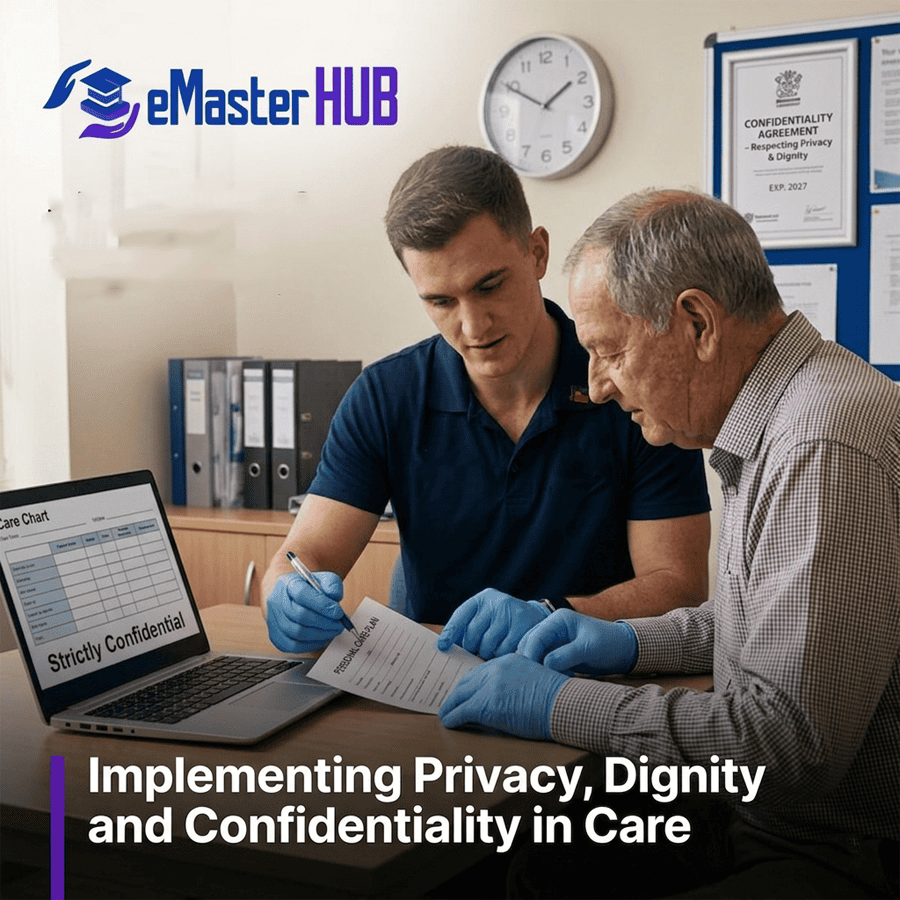
Implementing Privacy, Dignity and Confidentiality in Care
Code:
This course provides a foundational yet practical guide to upholding the fundamental rights of individuals receiving support. It focuses on the customization of care practices to ensure that every interaction respects the personal space, autonomy, and inherent value of the participant.
Associated Courses
Associated Courses
A$20.00
Approx. 1.5–2 hours total
English
100% online (mobile + desktop)
Instant digital certificate on completion
Preview Mode
Implementing Privacy, Dignity and Confidentiality in Care
HD Quality
Subtitles
Lifetime Access
Need Help? Talk to Our Support Team
Have questions about our courses? Our friendly support team is ready to help you choose the right program, guide your enrollment, and start learning today.

Built by leaders who live and breathe professional growth.
Gain up-to-date skills for supporting people and families in varied situations.
In everything we do, we aim to:
- Turn complex professional goals into clear, actionable growth strategies. We replace "one-size-fits-all" advice with deep customization that addresses the specific challenges of your role and your community.
- Give professionals mastery, not just a resume boost. We focus on building genuine capability and the confidence to lead, ensuring every milestone translates into a measurable community outcome.
- Give organizations a seamless way to keep their teams evolving, aligned, and future-proof. We provide a structured path to excellence that makes it easy to track progress, develop talent, and stay ahead of industry shifts.
The eMaster HUB Advantage
Australian-Relevant
Courses are developed by industry experts with deep experience in Australian community services.
Flexible, Online Learning
Courses are delivered online for 24/7 access, ideal for regional teams, busy professionals, and those with multiple commitments.
Practical and Interactive
Each module includes case studies, real-world scenarios, and interactive activities.
Real-world experience
Expert-led, Australian-proven. We teach from real-world experience, not a manual.
- Frequently Asked Questions
Quick Answers for You
We’ve gathered the most common questions about eMaster HUB to help you get information faster. Whether you’re curious about our courses, certifications, or compliance with Australian standards, you’ll find the answers here.
1. What do social work short courses include?
Social work short courses often concentrate on specific topic areas like community outreach, domestic violence, case planning, or safeguarding. They are ideal for professionals seeking targeted development or additional expertise in thematic areas of interest.
2. Who should consider enrolling in drug and alcohol courses?
These courses are well suited to new entrants to the sector, existing support workers seeking skill enhancement, social workers needing continuing professional development, or anyone interested in roles like case management, drug and alcohol support, or domestic violence advocacy.
3. How long do domestic violence online classes take?
Duration varies: short introductory or micro-credential courses can be completed in a hour or two, whereas more intensive professional-development or case management courses may take few hours, depending on depth and delivery mode.
4. Do I receive a certificate after completing these courses?
Yes. our courses come with a certificate of completion which helps validate your skills for employers in community services, social work professional development, or allied health sectors.
5. What skills will I gain from a case management short course?
A case management short course equips you with practical skills in client assessment, individual care planning, service coordination, referral processes, and outcome evaluation. These skills are essential in disability case management, aged care case management, and broader social work contexts.
eMaster HUB: Your dedicated partner
- Emaster is a dedicated growth catalyst designed to bridge the gap between individual professional excellence and broader community success. We believe that progress is most powerful when it happens at every level.